
Against Road Noise and Restless Neighbors: Let's Count the Decibels
The physics in one paragraph
Sound is blocked by two things: mass and the absence of gaps. The heavier the barrier, the more sound energy it stops (acousticians call this the "mass law"). And even a small gap — between boards, under the fence, at a post — lets noise pour through like water through a hole in a bucket. A fence that is light, thin, or full of gaps simply cannot be a sound barrier, no matter how tall it is.
Precast concrete fence: mass where it matters
A solid precast concrete fence panel weighs about 16 lbs per square foot — 5 to 8 times more than a wood fence and up to 15 times more than vinyl. That mass is exactly what the physics calls for. A properly installed solid concrete fence typically cuts traffic and neighborhood noise by 50% or more of perceived loudness — the difference between hearing every passing truck and hearing a faint hum.
Highway departments build their sound walls from concrete — not wood, not vinyl. The same principle works at backyard scale.
Now in numbers
Here's what acousticians and highway engineers (FHWA — the Federal Highway Administration) report.
Perception benchmarks: minus 3 dB is barely noticeable, minus 10 dB feels like "half as loud," and minus 20 dB feels like "one quarter as loud."
For scale: a busy road next to your property runs 65–75 dB (for comparison: 60 dB is normal conversation, 70 is a vacuum cleaner a few feet away). The FHWA treats 67 dB as the threshold where noise becomes a problem for homes and sound walls get built. And moving deeper into the lot barely helps: every doubling of distance from the road cuts only about 3 dB.
What fences actually deliver:
Cedar picket with gaps: minus 2–4 dB — hardly any difference.
Solid vinyl: minus 4–6 dB — slightly quieter.
Solid concrete, 6 ft: minus 10–15 dB — half as loud or better.
Wood fence: light boards and gaps — sound passes right through
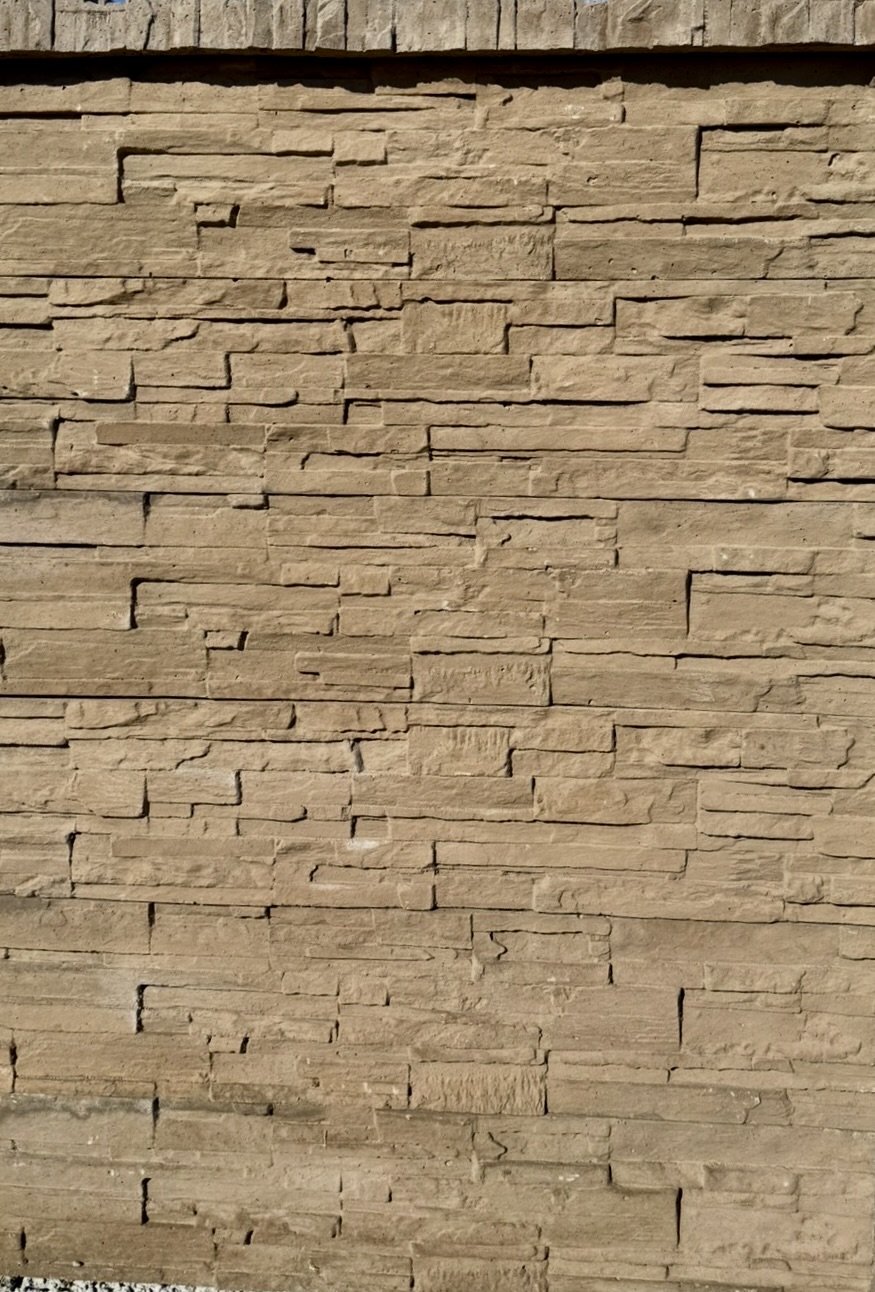
Solid precast concrete: no gaps, 8x the mass of wood
The physics behind the gap: with concrete, sound simply doesn't pass through the panel (at ~16 lbs per square foot, the calculated transmission loss through the material is ~38–40 dB — that path is effectively closed). What remains is the sound bending over the top of the fence — and that's what limits the result to 10–15 dB. Wood and vinyl are the opposite: sound passes freely through gaps and lightweight panels, so no amount of height helps them.
Two practical takeaways: every additional foot of height on a concrete fence adds roughly another 1.5 dB (with wood — nothing), and the effect is greatest when the fence stands close to the noise source or close to your patio — not halfway between them.
Putting it all together: a road by your property is ~70 dB; a solid concrete fence takes off 10–15, leaving 55–60 dB in the yard — the level of calm conversation. A wood fence takes off 3 — it was 70, and it stays practically 70.
The bottom line
If noise is your problem, a fence upgrade only works when it adds serious mass and closes every gap. In Texas, that means concrete.
